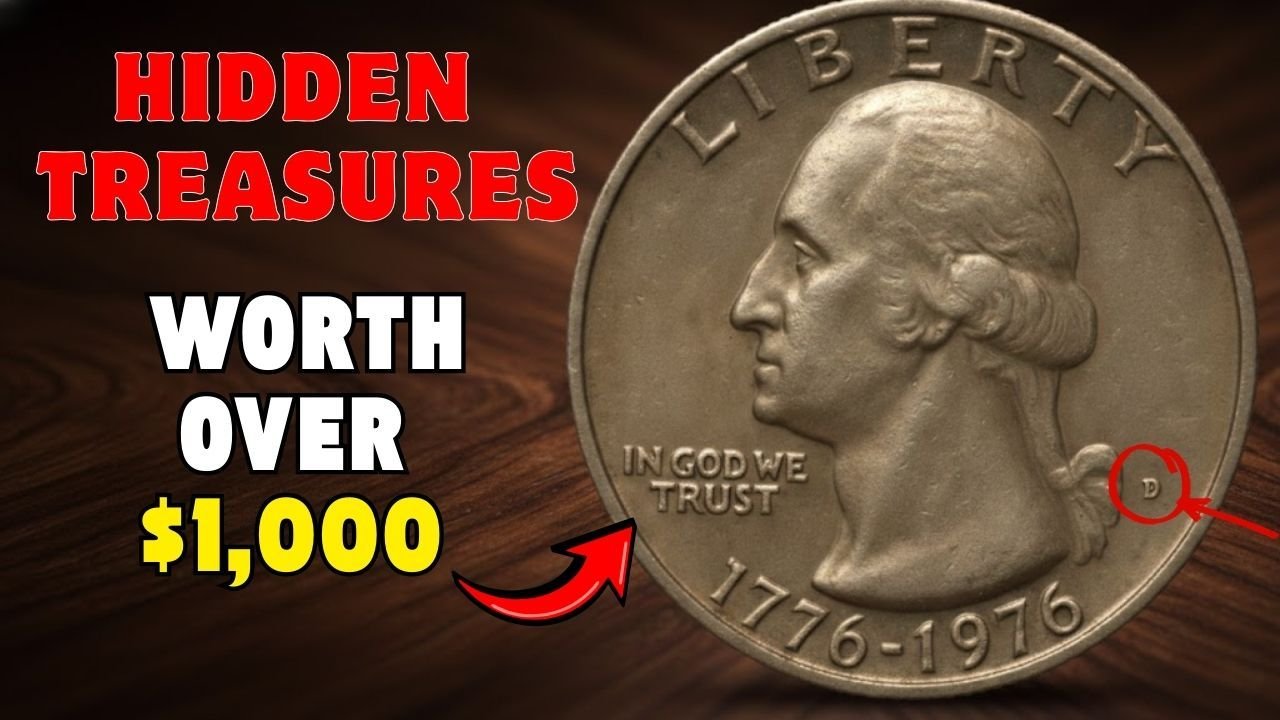
Washington quarters have been a staple of U.S. coinage since 1932. For most people, they are everyday coins used for parking meters, vending machines, or spare change jars. Yet within this long-running series, a small group of quarters stands far above the rest in terms of rarity and value. Because of low mintages, historic circumstances, and unexpected minting errors, some Washington quarters are now worth well over $1,000 and continue to appreciate as collector demand grows.
For serious collectors and curious beginners alike, understanding these rare quarters is essential. They prove that even familiar coins can carry remarkable financial and historical significance when the right factors align.
Why Some Washington Quarters Become Valuable
Not all rare coins are old, and not all old coins are rare. The value of Washington quarters is driven by a combination of limited production, errors at the U.S. Mint, survival rates, and condition. Coins that were heavily circulated, poorly stored, or overlooked for decades are much harder to find today in collectible condition.
Professional grading and authentication also play a major role. A difference of just one grade level can mean hundreds or even thousands of dollars in value, especially for key dates and error coins.
1932-D Washington Quarter
The Original Key Date
The 1932-D Washington quarter is widely regarded as the most important key date in the entire series. Struck at the Denver Mint during the first year of production, it had a relatively low mintage compared to later issues. Many of these coins entered circulation immediately during the Great Depression, leading to heavy wear.
Even examples in modest condition are desirable. Well-preserved pieces with clear details and minimal wear often exceed $1,000, while higher-grade examples can command much more at auction.
1932-S Washington Quarter
Scarcer Than the Denver Issue
The San Francisco counterpart to the 1932-D is even rarer. With a lower mintage and similar circulation history, the 1932-S Washington quarter is one of the most sought-after coins in U.S. numismatics. Most surviving examples show significant wear, making clean specimens exceptionally valuable.
Collectors working to complete a full Washington quarter set consider this coin essential. In lightly circulated condition, values frequently cross the $1,000 threshold, with mint-state examples reaching substantially higher prices.
1943 Washington Quarter With Doubled Die Error
A Wartime Rarity
World War II placed enormous pressure on U.S. Mint production, increasing the likelihood of errors slipping through. One of the most notable is the 1943 doubled die obverse Washington quarter. The doubling is most visible on the date and lettering, creating a distinct appearance under magnification.
Because these errors were not immediately detected, some entered circulation. Clear, well-defined doubled die examples with minimal wear are highly prized and can sell for well over $1,000 depending on condition and clarity of the error.
1950-D Over S Washington Quarter
A Mint Mark Mistake
The 1950-D over S quarter is a classic example of a repunched mint mark error. In this case, a Denver mint mark was stamped over an existing San Francisco mint mark. Traces of the original “S” can still be seen beneath the “D” when examined closely.
These errors occurred when dies were reused or modified, and surviving examples are relatively scarce. High-grade coins are especially desirable among error coin specialists and regularly exceed $1,000 in value.
1965 Washington Quarter Struck on Silver Planchet
An Accidental Treasure
In 1965, the U.S. Mint transitioned quarters from 90 percent silver to a copper-nickel clad composition. During this changeover, a small number of quarters were mistakenly struck on leftover silver planchets from 1964.
These coins were never meant to exist, which makes them particularly valuable. They weigh slightly more than standard clad quarters and produce a distinctive sound when dropped. Certified examples of this error often sell for several thousand dollars, making it one of the most exciting modern discoveries in the series.
1970-S Proof Washington Quarter Without Mint Mark
A Proof Coin Error
Proof coins are carefully made for collectors, yet mistakes can still happen. The 1970-S proof Washington quarter missing its mint mark is one of the most famous proof errors. Normally, all San Francisco proof coins carry an “S” mint mark, but a small number were released without it.
These coins went unnoticed for years before being identified by collectors. In top proof condition, they are highly valuable and frequently sell for more than $1,000, with long-term growth potential.
1983-P Washington Quarter in Mint State
A Modern Sleeper Coin
At first glance, the 1983-P Washington quarter appears ordinary. However, that year is unusual because official mint sets were not issued. As a result, far fewer high-quality examples were preserved at the time of release.
Finding an uncirculated 1983-P quarter with strong luster and no marks is surprisingly difficult today. Certified mint-state examples in top grades have sold for over $1,000, making this coin an unexpected standout among modern issues.
Why These Rare Quarters Matter
Rare Washington quarters offer more than financial value. They reflect changes in U.S. history, economic pressures, and evolving minting practices. From Depression-era scarcity to wartime errors and modern production gaps, each coin tells a story that connects collectors to the past.
For anyone interested in coin collecting, learning about these quarters is an important step. While discovering one in circulation is unlikely, it is not impossible. With patience, education, and careful inspection, even a simple quarter can turn out to be far more valuable than it appears.
In a world where opportunities often hide in plain sight, these rare Washington quarters prove that remarkable value can still be found in the most familiar places.